
🧠 How to Approach a System Design Problem
Practical Guide

Whether you're solving a system design question in an interview or architecting a real-world application, success depends on a structured, methodical approach. System design isn’t about throwing buzzwords onto a whiteboard — it's about deeply understanding requirements, choosing trade-offs wisely, and designing systems that are scalable, reliable, and maintainable.
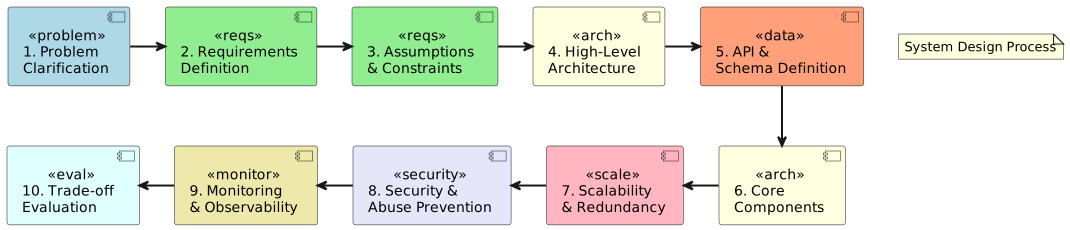
👉 To approach system design effectively, here’s a proven 10-step framework you can follow every time:
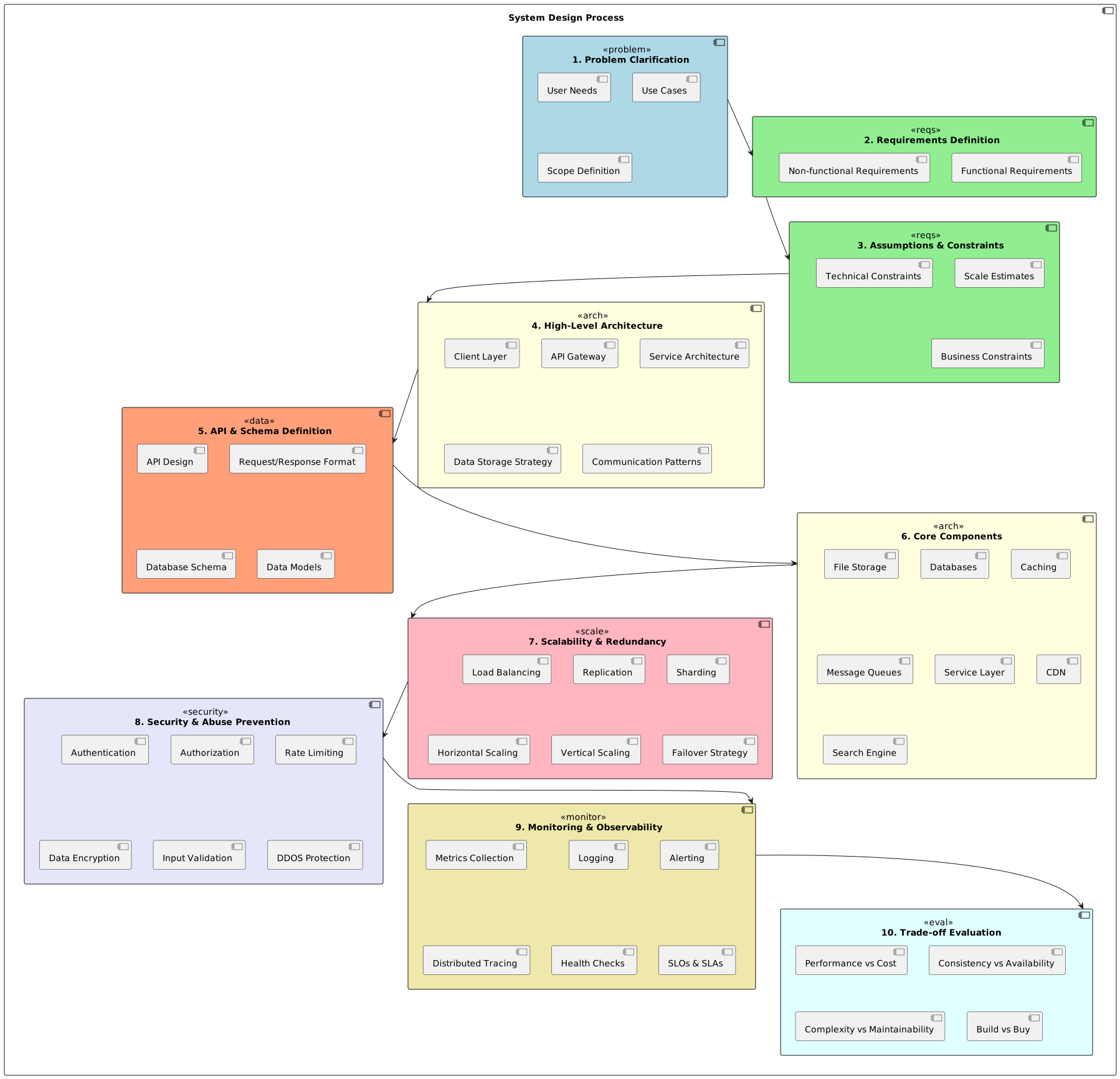
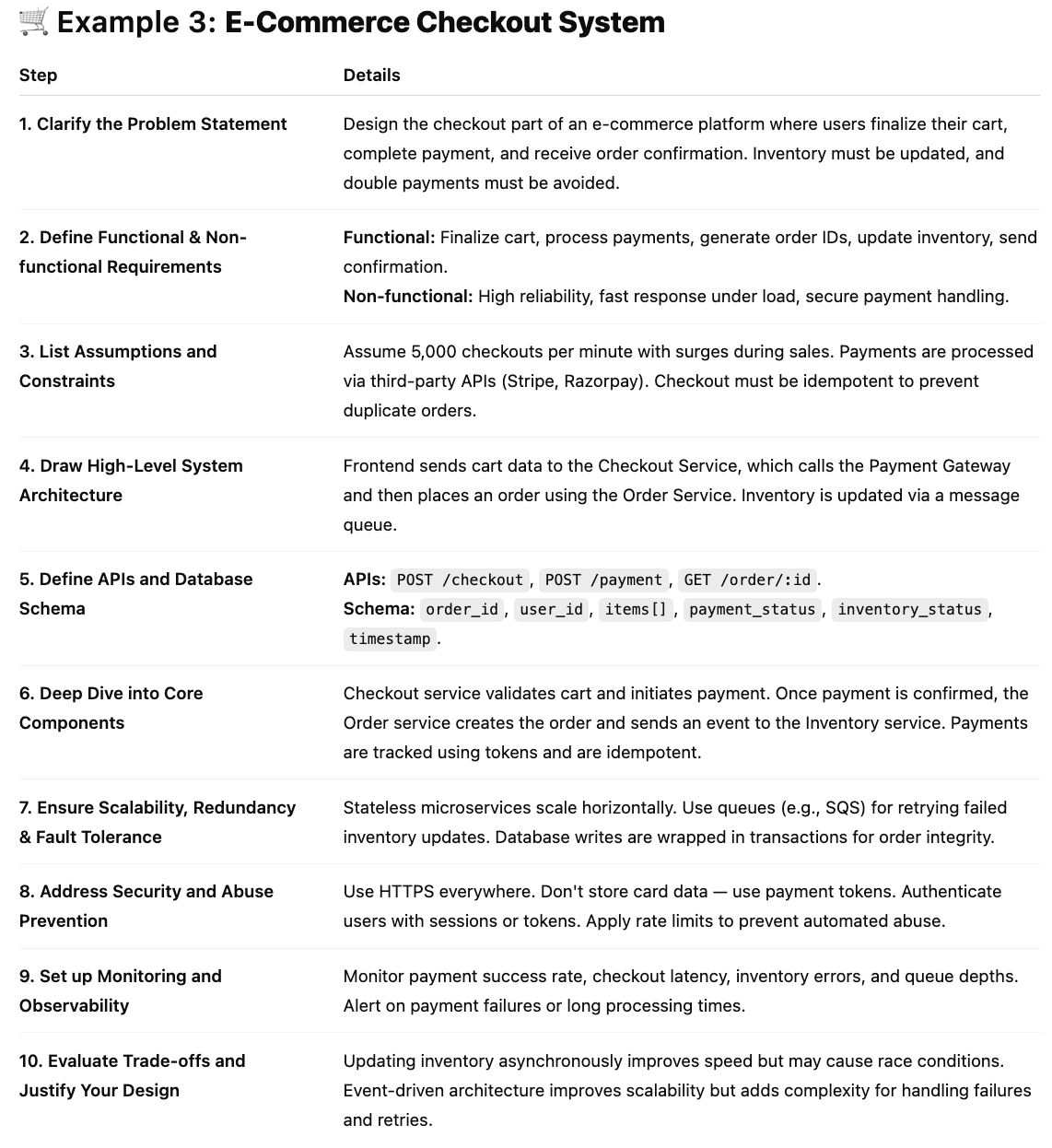
Clarify the Problem Statement
Define Functional & Non-functional Requirements
List Assumptions and Constraints
Draw High-Level System Architecture
Define APIs and Database Schema
Deep Dive into Core Components
Ensure Scalability, Redundancy & Fault Tolerance
Address Security and Abuse Prevention
Set up Monitoring and Observability
Evaluate Trade-offs and Justify Your Design
1. Clarify the Problem
Start by understanding exactly what you're being asked to design. Don’t rush into drawing components until the requirements are crystal clear. Ask clarifying questions. Who are the users? What are the expected use cases? Are you building this from scratch, or evolving an existing system?
For instance, if the prompt is “Design a URL shortener,” you might ask: should it support custom aliases? Should the URLs expire? Will analytics (clicks, location, device type) be tracked? These questions help reveal the functional scope of the system. Asking the right questions shows depth of thinking and ensures you don’t waste time designing for imaginary requirements.
2. Define Functional and Non-Functional Requirements
Once the problem is defined, break it down into functional requirements (FRs) — the features and capabilities the system must offer — and non-functional requirements (NFRs) — performance, reliability, scalability, and availability expectations.
Functional requirements describe what the system should do. For a chat system, this could include sending messages, group creation, typing indicators, message history, and media attachments.
Non-functional requirements, on the other hand, relate to how the system performs. You should ask: What is the expected latency per request? How many concurrent users must it support? Is eventual consistency acceptable? Does the system need 99.99% uptime?
These NFRs guide your technical decisions throughout the design.
3. Identify Constraints and Make Assumptions
Not every problem comes with numbers. Often, you must make educated assumptions about the system’s scale and load. Estimating the number of users, reads/writes per second, or total data storage is crucial because it informs decisions about scaling strategies, database choices, and caching layers.
Also define constraints: Are there specific tools, platforms, or cloud providers that must be used? Is the system read-heavy or write-heavy? Does it need to support real-time operations or batch processing?
Being explicit about assumptions shows you understand how design changes at different scales.
4. Design the High-Level Architecture (HLD)
At this point, sketch out the high-level system design — the macro view of components and how they interact. Most systems will involve a client (browser or mobile), an API gateway or load balancer, an application server layer, databases, caching, and sometimes a message queue or pub/sub system.
Start simple. You can add complexity later.
For example, in a social media app:
The frontend calls the API Gateway
The gateway routes to microservices (Auth, Posts, Notifications)
Data is stored in SQL (for users and posts) and NoSQL (for comments or reactions)
Redis handles frequently accessed data like trending posts
Kafka handles event streams like “user followed” or “new post created”
Think modularly. Each component should ideally scale independently.
5. Define Key APIs and Data Models
With your system's core flow in place, start detailing key APIs and the data schema. This step is often overlooked but is critical for understanding how components interact and what data flows through them.
Design RESTful endpoints or GraphQL queries. Define request/response formats, HTTP methods, status codes, and authorization mechanisms.
For example, for a URL shortening API:
POST /shortento create a new short URLGET /{short_code}to redirect to the long URL
Accompany this with a basic schema:
CREATE TABLE urls (
  id SERIAL PRIMARY KEY,
  long_url TEXT,
  short_code VARCHAR(8) UNIQUE,
  created_at TIMESTAMP
);
Good API and schema design reflect real-world usage and constraints — for instance, using proper indexes for fast lookups.
6. Deep Dive into Each Component
Once the high-level view is done, start exploring each major component in detail:
Database: Decide between SQL and NoSQL based on the system’s needs. For consistency and relational data, SQL is better. For scalability and schema flexibility, NoSQL may be more suitable. Discuss replication (for fault tolerance) and sharding (for scaling), indexing (for performance), and backup strategies.
Caching: Discuss what data can be cached (e.g., user profiles, static content), and where to place caches (client-side, CDN, server-side, or DB query cache). Mention eviction strategies (LRU, LFU), TTLs, and invalidation techniques.
Load Balancing: Consider how to distribute requests across backend servers. Explain layer 4 (TCP-based) vs. layer 7 (application-level) load balancing. Talk about strategies like round-robin or least connections and mention sticky sessions if needed.
Queues and Asynchronous Processing: If the system has tasks that don’t need to complete immediately (e.g., sending emails, image processing), use a message queue. Kafka, RabbitMQ, and Amazon SQS are popular. Also mention dead-letter queues and retry mechanisms.
File Storage: For user-uploaded content like images or videos, use blob storage such as AWS S3 or Google Cloud Storage. Consider CDN integration for performance.
By this point, your architecture should not just be working — it should be scalable, fault-tolerant, and modular.
7. Plan for Scalability, Fault Tolerance & Redundancy
Now stress-test your design.
What happens under high load?
What happens if a database node fails?
Is there a single point of failure (SPOF)?
Introduce replication and failover. Use multi-region deployments for geo-resilience. Apply horizontal scaling for services and databases using techniques like stateless service deployment and consistent hashing. Add read replicas for scaling read-heavy loads and leader-follower replication for databases.
Include circuit breakers to prevent cascading failures, rate limiters to avoid abuse, and timeouts with retries for reliability.
8. Discuss Security Considerations
No system is complete without security. Discuss authentication and authorization. Use JWTs or OAuth for user sessions. Implement role-based access control for internal features.
Always encrypt data at rest (e.g., in databases) and in transit (TLS). Sanitize user input to prevent SQL injection or XSS attacks. Use rate limiting and CAPTCHA to prevent DDoS and abuse.
Security is often neglected in interviews, so bringing it up shows maturity.
9. Monitoring, Logging, and Observability
A well-designed system needs to be observable in production. Integrate monitoring tools (Prometheus, Datadog, AWS CloudWatch) to track key metrics: request rate, error rate, latency, CPU/memory usage.
Use centralized logging tools like ELK (Elasticsearch, Logstash, Kibana) or EFK (Fluentd) for log aggregation. Add distributed tracing (Jaeger, Zipkin) for understanding request flow across microservices.
Also, define SLOs, SLAs, and SLIs to measure reliability and set alerting thresholds.
10. Consider Trade-offs and Alternatives
At every step, you’ll face trade-offs: SQL vs NoSQL, consistency vs availability, caching vs real-time updates, monolith vs microservices.
Don’t just say "use Redis" — explain why Redis makes sense for low-latency reads and key-based access patterns. Or why Kafka is preferred for decoupling services with high throughput needs.
A good design is never perfect. A great designer knows what they’re optimizing for and can justify their choices.
Practical Examples:
High level Process:
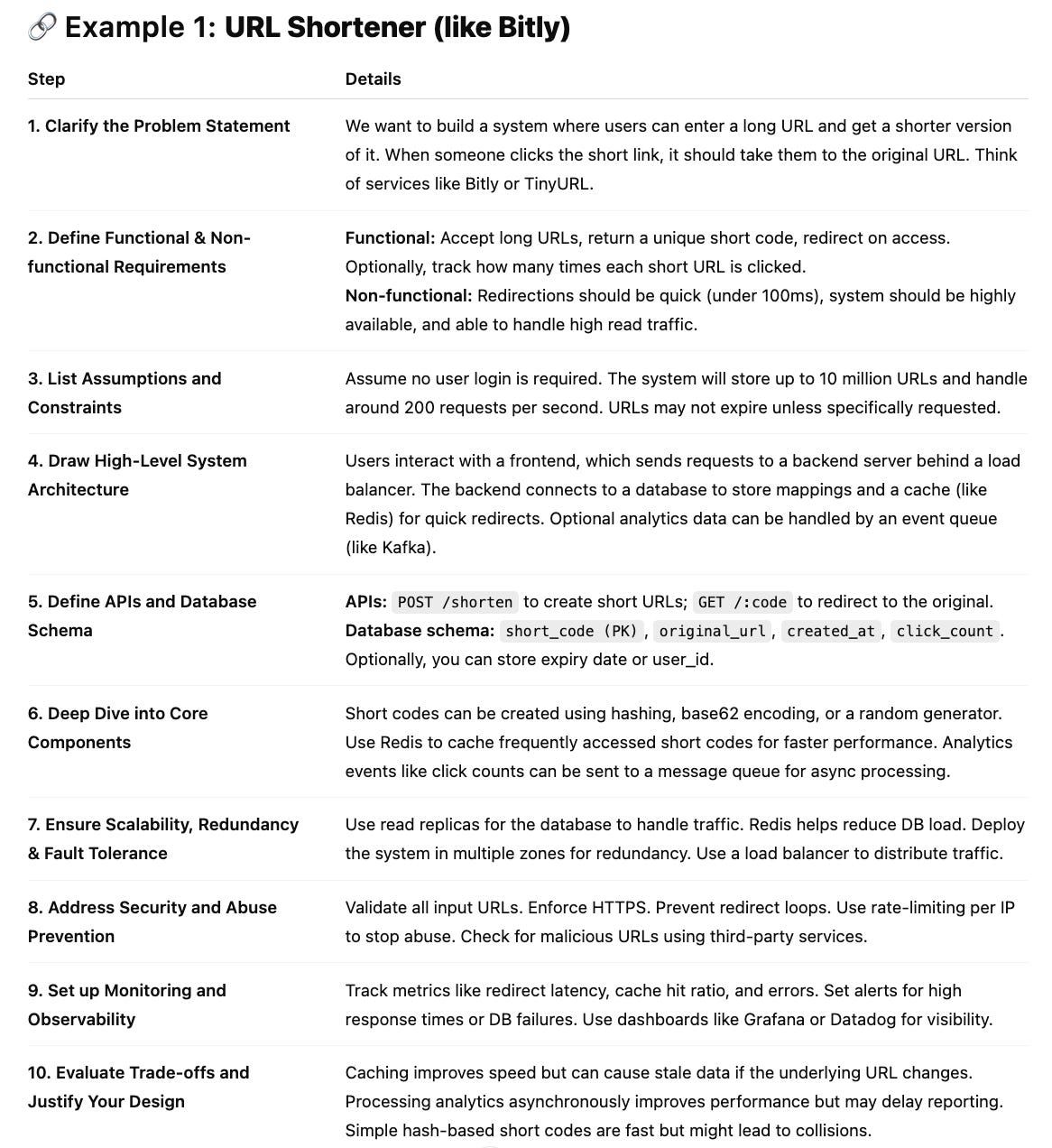
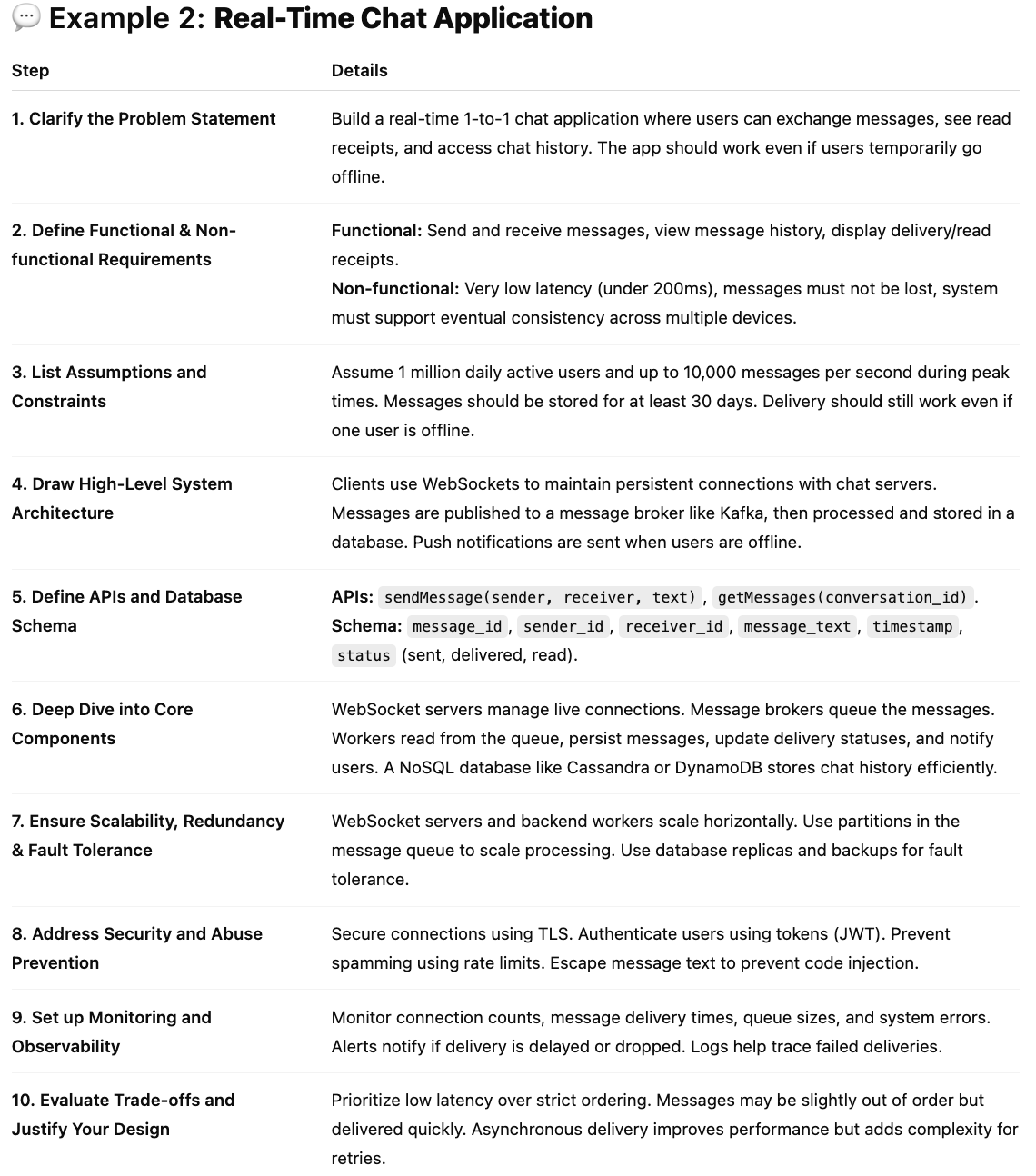
Examples:
Thanks for reading! Subscribe for free to receive new posts and support my work.